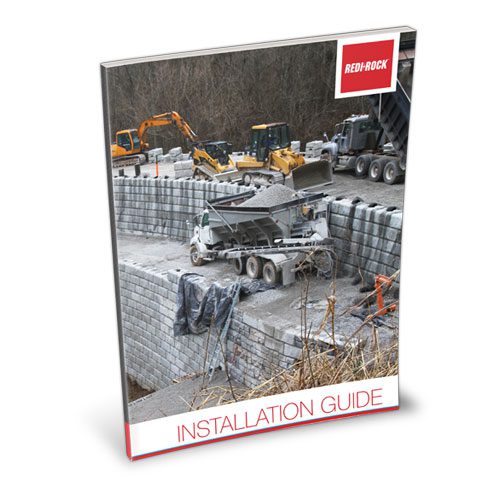
Redi-Rock Retaining Wall Blocks

J&R Precast is a trusted manufacturer and supplier of Redi-Rock freestanding and retaining wall blocks.
Our Redi-Rock installations near you
Seeing is believing!
Visiting a Redi-Rock installation site is the best way to give you a true sense of these retaining walls' size, quality, and elegance. This interactive map will help you locate a Redi-Rock installation near you.
Whether you're looking to touch the block, see it in the real world, or be inspired, we hope this tool serves you well.
Redi-Rock overview
J&R Precast - One of New England's leading producers and suppliers of Redi-Rock.
Redi-Rock is an industry-leading interlocking retaining wall system for building tall gravity walls and even taller reinforced walls.
The Redi-Rock retaining and free-standing wall systems utilize an innovative and unique series of knob and groove technology resulting in a self-aligning system.
This engineered solution allows the entire structure to interlock with each other minimizing excavation on-site and reducing the need to use expensive geo-grid or tie-back systems. The J&R Precast Redi-Rock system features a unique and attractive Ledgestone and Split Limestone appearance that mimics the look of natural stone.
All J&R precast Redi-Rock products are manufactured to meet or exceed all state and ASTM standards.
Redi-Rock Advantages
- Fast and easy installation
- Reduced labor costs
- Less excavation is required, and less space is needed for installation
- Versatile - Installs where small block systems are not practical
- Leverages machine labor and a small crew giving Redi-Rock a distinct advantage in performance and installation costs.
J&R Precast Redi-Rock comes in three sizes and two faces - 60", 41", & 28"
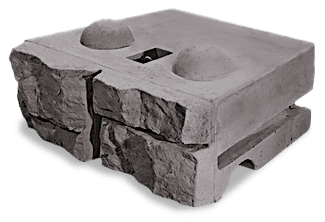
Ledgestone
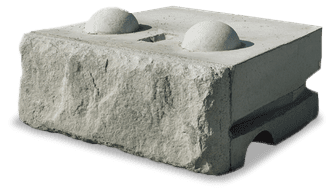
Limestone
Field Insights
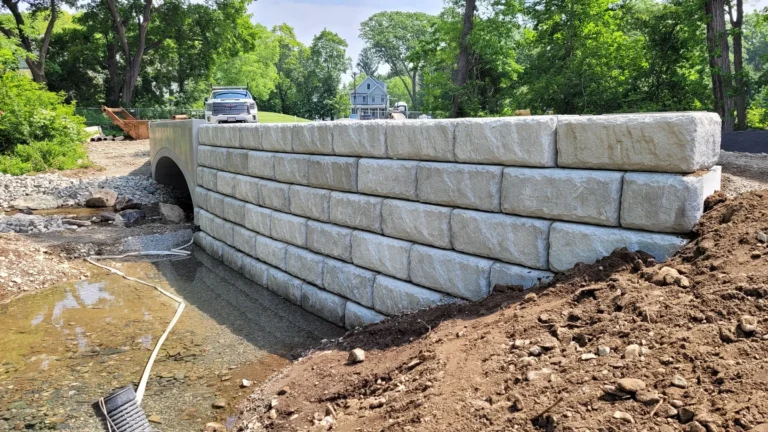
Why Dewatering Is the Difference Between Retaining Walls That Last — and Ones That Move
In New England, retaining wall problems rarely start with the wall itself. They start with the soils and ground underneath. Seasonal groundwater, glacial soils, coastal conditions, and freeze-thaw cycles combine in ways that generic retaining wall designs often underestimate. In our region, overlooking dewatering isn’t just a technical miss — it’s one of the most common reasons otherwise well-engineered walls begin to shift within a few winters. Before block selection, wall height, or finishes are ever discussed, controlling groundwater is often the single most important step in building a retaining wall that performs long-term in Massachusetts, Rhode Island, and Southern…
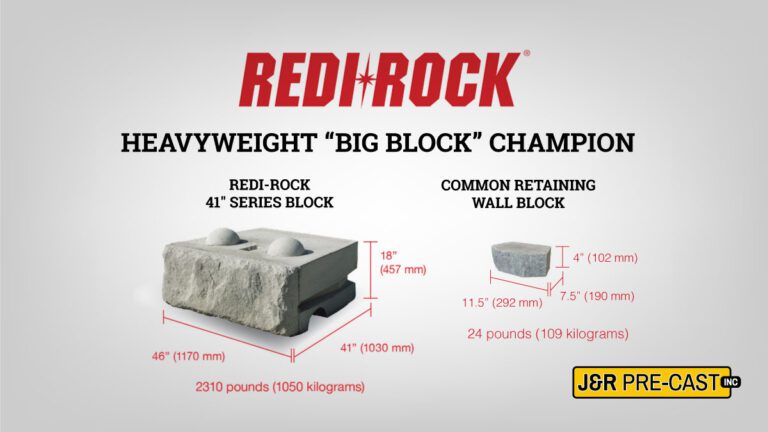
4 Reasons Why Redi-Rock is the Heavyweight Champion of Retaining Wall Systems
Redi-Rock “Big Blocks” come in various sizes, but on average, they weigh about 1 ton each. In comparison, smaller blocks typically weigh between 20 and 120 lbs, highlighting why these are referred to as “big.” Our 2,000-pound blocks perform like their smaller counterparts in holding back earth but offer distinct advantages. 1. Efficiency in Installation Traditional retaining wall blocks often require large crews and extensive manpower for installation. In contrast, our big block systems can be set with machine labor and a small crew, significantly reducing installation costs and improving efficiency. Yet, the most exciting benefit lies in installation and…
Redi-Rock applications
Where do you use Redi-Rock systems?
Redi-Rock gravity walls and retaining walls were invented to serve the need for an architecturally pleasing yet cost-effective structural retaining wall solution – perfect for the New England terrain and climate.
Redi-Rock applications are not limited to just “standard” retaining walls. Use Redi-Rock from J&R Precast as a superior retaining wall system specifically developed to meet the most demanding structural needs for projects like:
Why do designers & contractors choose Redi-Rock?
Designers love the aesthetics, functionality, and flexibility that Redi-Rock provides
For contractors, Redi-Rock looks excellent and is easy and more economical to install than most wall systems.
Residential
- Driveways
- Decorative
- Waterfront, waterway, and shore protection
- Enhanced landscaping, patio, yard expansion
- Garage Under/Wing Walls
Commercial
- Golf Courses
- Parks and Recreation
- Parking lots
- Walkways
- Bridges/Overpasses
- Culverts
- Headwalls
Industrial
- Retail or Box Stores
- Housing Developments
- Free Standing Walls
- Building Security
- Manufacturing Facilities
Municipal
- Airports
- Military
- Cemeteries
- Highway Retentions
- Above grade guardrail systems
- Railroad and waterway
Redi-Rock product lines
Gravity Blocks
Available in 60", 41", 28", and 16" sizes
Stairs
Dimensions: 7"H x 48"L x 26" D
Freestanding Hollow Core Block
Dimensions: 7"H x 48"L x 26" D
Caps
Dimensions: 6"H x 48" L x 28"D
Freestanding Walls
Split-Limestone or Ledgstone
Force Protection Walls
Dimensions: 18"H x 46"L x 23"D
Redi-Rock installation
How do you install Redi-Rock?
A high-level overview of the basic installation process for Redi-Rock retaining wall systems
- Site preparation and location
- Ground Preparation to Create a Leveling Pad Placement
- Backfill Leveling Pad
- Excavate to the lines and grades on the construction drawing
- Install block units. Position blocks to be offset from seams of blocks below. Blocks shall be placed fully forward so the knob and groove are engaged.
- Check each block for proper alignment and level. Backfill to 12-inch width behind the block with free-draining backfill.
Different site preparations and conditions can make installation more or less complicated. For more in-depth installation instructions, you will want to review the PDF Instruction Manuals available for download here.
Additional Installation Videos
You want your walls to last forever, and mastering this critical first step is where you need to start! Watch the video to see a step-by-step overview of how to install this critical component.